Data Migration Testing: A Practical Framework for Safer Cloud Database Migration
Data Migration Testing: How to Validate a Successful Cloud Database Move
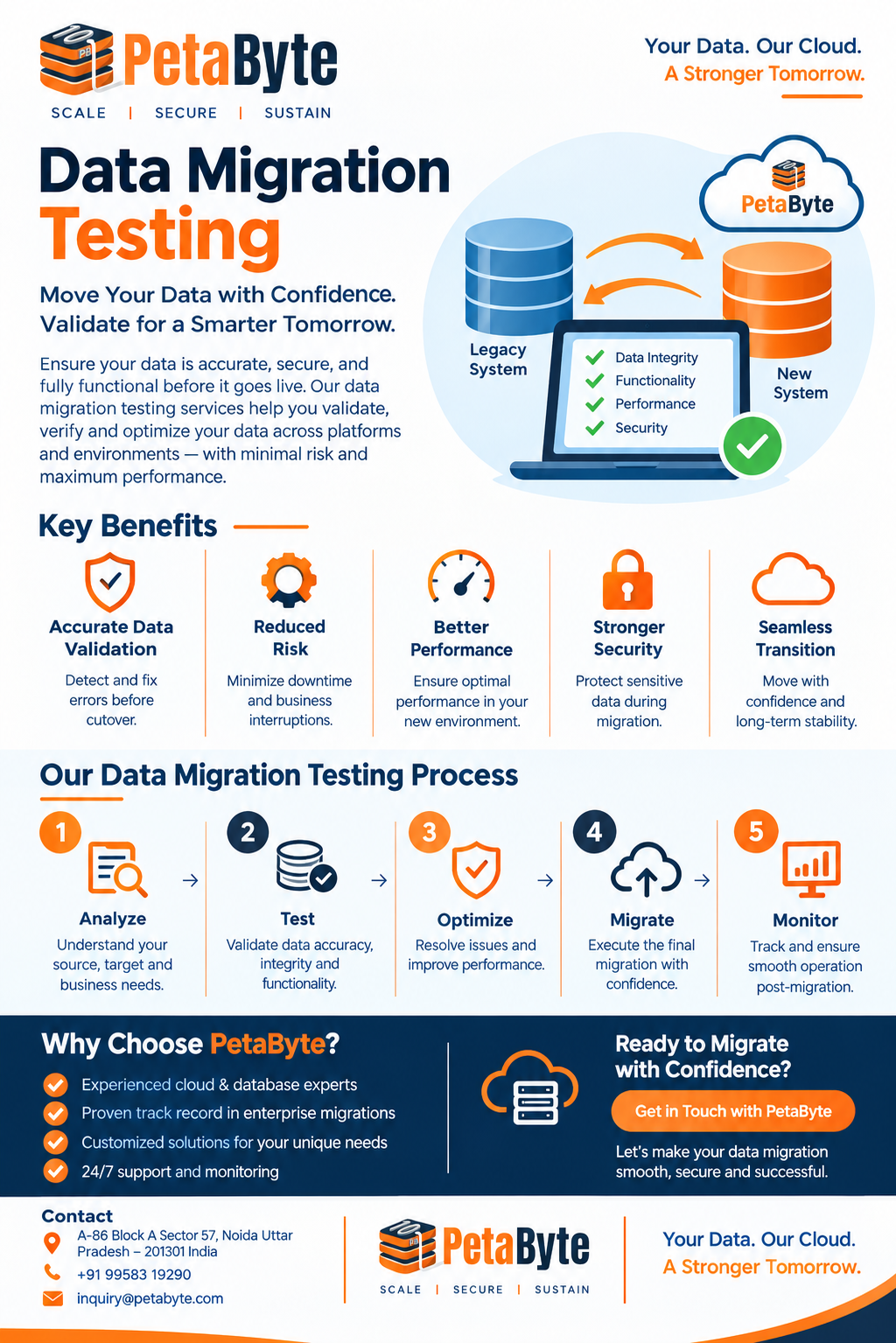
Migrating a database to a modern cloud environment can improve scalability, flexibility, and infrastructure management, but the transition also introduces technical challenges. A database contains more than individual records. It can include relationships, constraints, indexes, application dependencies, stored procedures, permissions, and business rules.
Because of this complexity, data migration testing should be an essential part of any serious database migration project.
The purpose of migration testing is to determine whether information has been transferred correctly and whether the destination environment can support the applications and workloads that depend on it.
- Understand the Source Before Migration
Testing should begin before the actual migration.
Technical teams should document the source database structure, important tables, data volumes, dependencies, data types, and business-critical information. Understanding the source environment makes it easier to establish meaningful validation criteria for the destination.
Data classification can also help identify which datasets require the highest level of testing.
- Create Clear Mapping Rules
Different database environments may use different schemas or data structures. A source field may need to be mapped to a different destination field, or a value may need to be transformed before it can be stored.
Mapping rules should therefore be documented and reviewed before migration.
This provides a reference point for testing and makes it easier to investigate discrepancies later.
- Validate Data Completeness and Accuracy
After migration, teams should verify that the expected information exists in the destination environment.
Record counts can provide a basic comparison, but they should not be the only test. Important records and fields should also be checked for accuracy.
Testing can identify:
Missing records Duplicate entries Incorrect values Truncated data Unexpected null values Formatting problems Incorrect data transformations
These checks become particularly important when dealing with large business databases.
- Check Relationships and Database Integrity
Many applications depend on relationships between different database tables.
Primary keys, foreign keys, indexes, constraints, and dependent records should be validated after migration. If these relationships are damaged, an application may produce incorrect results even though the individual records appear to be present.
Integrity testing therefore helps ensure that the migrated database remains structurally consistent.
- Test the Applications
The database is usually part of a larger technology ecosystem.
Applications, APIs, reporting platforms, dashboards, and internal tools may all interact with the migrated database. Functional testing should confirm that these systems can successfully read and process the migrated information.
Critical workflows should be tested before the final production cutover.
- Measure Performance
Performance can change after migration because the destination environment may use different infrastructure and configurations.
Teams should evaluate query execution times, application response times, concurrent workloads, resource utilization, and other relevant performance indicators.
This helps identify whether additional optimization or configuration changes are required.
- Include Security Validation
Migration testing should also consider security.
User permissions, application access, authentication, authorization, encryption, and logging should be reviewed in the destination environment. Sensitive information should remain protected throughout the migration process and after deployment.
- Perform Post-Migration Monitoring
Testing should continue after the production migration.
Real workloads can reveal issues that were not visible during a controlled test. Monitoring database performance, application errors, failed queries, and access behavior can help technical teams respond quickly to unexpected problems.
A documented recovery plan also provides additional protection if a critical issue occurs.
Building a Better Migration Strategy
The most effective migrations combine planning, controlled execution, validation, and continuous monitoring. Data migration testing provides the validation layer that connects these activities and helps organizations establish confidence in the final environment.